Following Ireland's last place finish with 5 points in the 2007 Eurovision song contest, the national broadcaster, RTÉ, is arranging the final preliminary round of choosing an Irish entrant for the 2008 contest. The final, to which the lucky entrant will be sent, is to be held in Belgrade, Serbia, on Saturday May 24th.
A controversial entrant is the puppet, Dustin the Turkey, whose presence in the competitions led to a short debate on the political television programme, Questions & Answers.
For those interested in following Irelands' and other countries' shortlisting and voting results, the site All Kinds of Everything has a very interesting blog and an extensive News section.
From The Irish Times:
"In the past some unkind critics have described Ireland's entries in the Eurovision as turkeys but this year we could actually have a turkey performing our entry.
"The Irish final will be held on February 23rd when the public decides who will represent Ireland at the Eurovision semi-final in Serbia in May. Already the turkey has ruffled feathers with one Eurovision fans' website reporting that Dustin is in the running, with the headline "Puppet to Mock Eurovision?"
"The Dublin turkey has an impressive CV, having run for president of Ireland, recorded with Bob Geldof and made a career out of insulting Pat Kenny and mocking Leitrim. But the puppet will have to pull some strings if he wants to make it to Belgrade. Bill Hughes, chairman of the judging panel, said Irish voters would have a very strong field to choose from.
"The other songs are:
Double Cross My Heart, performed by Donal Skehan and composed by Joel Humlén, Oscar Gorres and Charlie Mason; Time to Rise, performed by Maya and composed by Maja Slatinsek and Ziga Pirnat; Not Crazy After All, performed by Leona Daly and composed by Leona Daly and Steve Booker; Sometimes, performed by Liam Geddes and written by Susan Hewitt; and Chances, written and performed by Marc Roberts, who came second in the 1997 Eurovision Song Contest.
"Mr Hughes said the panel did not choose Dustin's song in a flippant manner. "We did think seriously about it but once we heard it and we all laughed so much we decided it was worth including."
"Ireland had never entered a novelty or humorous song before, he said, and it was just one of six songs for the public to choose from. John Waters, who co-wrote last year's Irish entry, was not getting into a flap over the prospect that his successor could be a turkey. "Don't forget that we are talking about the Eurovision. It's fun, it's kitsch and nobody takes it all that seriously," he said.
"He may have come last, but Waters believes that the turkey cannot lose, because of his novelty value. "If Dustin wins it's a victory and if he comes last it's a victory. The worst thing would be if Dustin came second-last. That would be failure as we would have beaten him." Dustin's election campaigns included promises such as bringing the Dart to Dingle, but he will have to step up his game as he bids for Eurovision glory. The only problem is, will Europe understand him when he shouts his catchphrase "Go on ya good ting"?"
Tuesday, February 05, 2008
Eurovision 2008 preliminaries off to a flying (or at least a feathered) start

Sunday, May 13, 2007
Eurovision 2007 over bar the shouting
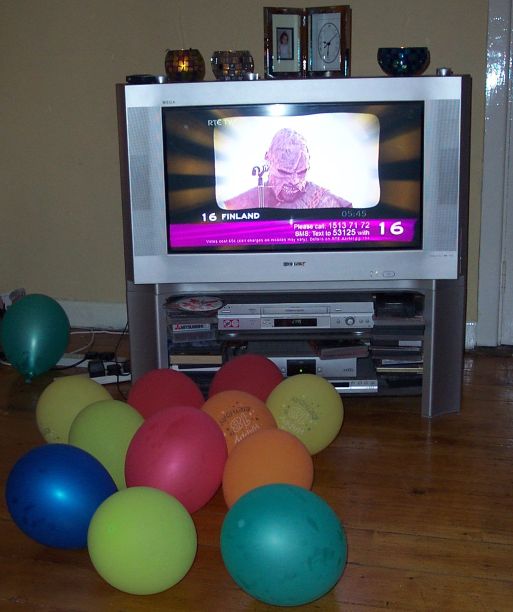
Finland's presentation of the 2007 Eurovision song contest started with a new high-production value video of last year's winning group, Lordi, performing the incomparable "Hard Rock Halluljah." Doubtless there will be complaints from those who object to zombies warming up the Arctic with flaming computer effects, but I thought it was a great investment.
I won't add much more about the quality of the commentary on Irish television channel RTE. It remained abyssmally low.
The show itself was disappointing for the average quality of most of the songs. It seems that many of the harder rock numbers which had been entered in the semi-final stages had not been voted through and so the final 24 acts were generally pop acts. The Eurovision has traditionally tended towards pop music and if voting in the semi-final is anything to go by it seems to be going back in that direction.
Ireland's entry, "They can't stop the spring," has had its music score revised since it first appeared on the Late Late Show "competition" from which it sprung (sorry!). One is reminded that competition judge Frank McNamara almost told Pat Kenny how bad the song was at that time. Europe didn't spare the Irish any blushes last night putting the song in its proper place: given 5 points by Albania and not a sausage by anyone else, Dervish's attempt to make John Waters out-of-date political dirge seem remotely entertaining failed utterly. We finished in last place for the first time in the competition. Already the post-mortem denials are starting this morning on Irish radio: the contest is "no longer a song contest, but a spectacle," etc. But the fact is, Dervish's singer is, to be kind, a niche singer and in a contest of this type appeared out of place and in the unforgiving live performance she sounded annoyingly nasal.
The contrived pulp-pop UK entry didn't fare much better and finished joint second-last.
For me, two acts stood out of the ordinary: The Moldovan entry, Fight, performed by Natalia Barbu, who gave a masterly live vocal demonstration, and the entry from Slovenia, Cvet Z Juga, performed by Alenka Gotar. And no, I have no idea what Cvet Z Juga means...
Internet rumour has it that Finnish metal band, Nightwish, may be interested in inviting Alenka Gotar to join them to replace estranged lead singer, Tarya Turunen. I hope it's true.
The interval act was an entertaining mix of heavy rock music played by cello, acrobatic trapeze artistes and circus performers.
Countries whose entries had been eliminated in the semi-final stage were still qualified to vote, and so the competition had the potential for going on interminably at the voting stage. This was avoided by the instant application of the lower votes to the scoreboard and the calling out of the 8 point, 10 point, and 12 point awards of each country. While it meant the logistics of the competition were improved it did require a little mental and visual agility among viewers as the scoreboard rapidly changed.
In the end, Serbia, entering the competition for the first time, won with its ballad, Molitva, performed by Marija Šerifovic. It sounds like a traditional Eurovision winner and it has to be said Marija Šerifovic has some pair of lungs on her... whatever it is she's singing about..(!)
So, all over bar the shouting, the hangovers, the accusations, blame, and most of all the lack of any lesson learned. Will I be watching it again next year? I hope so. Will RTE produce something likely to win? Not without taking the courage to NOT send something sub-standard. Quality WILL win out over bloc-voting.
Saturday, May 12, 2007
Marty Whelan's Eurovision comments

Friday, May 11, 2007
How could you dislike Eurovision when songs like this one win?
I'm looking forward to the harder rock that is Eurovision 2007. Well, not exactly hard rock. Kind of a little tougher than talcum perhaps. I've seen some of the entries.... BUT! Lordi won in 2006, so the general trend in '07 is towards a more rock 'n' roll sound, if not a metal approach. I've been humming Hard Rock Hallelujah all day.
The Irish entry this year is a regrettable one. As Mr Gump said: "That's all I want to say about that."
For our non-Euro visitors, the Eurovision song contest is held annually in Europe where original (and occasionally some suspiciously non-original) songs are performed by representatives of most of the countries of Europe and some of the near east. The original idea was to foster peace and harmony. The event is televised in the participating countries and viewers vote by telephone. Viewers cannot vote for their own country's entry.
Songs tend to be light pop or worthy folk in character. The competition is generally considered to be old-fashioned, staid, and unwatchable. Secretly it has one of the biggest television audiences of the year. Somehow we always seem to be "just flicking through channels" and hit on the programme. The song by Lordi, in the video, above, won in 2006, to the surprise of quite a few people. As the winners, Finland gets to host the programme in 2007.
The competition has become so big in recent years that not all countries eligible to perform are allowed to automatically qualify and effectively two contests exist, the first a few days before the final being a kind of semi-final for countries who scored lower in the ranks in the previous competition. Although politics are barred from the event, some songs seem to have some political messages this year. Also voting for neighbouring countries and political partners is rife and makes the task of smaller countries all the more difficult.
The 2007 event final takes place this Saturday night, 12th May.